Pages

Showing posts with label Georgia. Show all posts

Saturday, 30 June 2012

Lezginka, The Caucasian War Dance

The Lezginka is a Caucasian dance named after the Lezgis that is danced all over the Caucasus, by Georgians, the Armenians, the Chechens, and the many other cultures who are home to the Caucusus. This article also contains the basic description of the moves involved in the Lezginka.


The strange thing about Lezginka and the various videos of the dance on sites like Youtube, is that there seems to be a war, fought in the comments sections, over whether it is an all male dance, or whether it is a dance that includes one or more women. Some maintain the former, some the latter, and others maintain that the Lezginka includes women, but that there is another all-male dance called the Mkhedruli ("military" in Georgian).


I think the answer is that it's all one dance that went through a historical change. It started out as an all-male war dance, like this scene from the Russian made movie, 12, were a boy dances the Lezginka with Chechen Rebels resting at his fathers farm:


Or, if you'd prefer a more real-life example, consider this clip of Chechens dancing The Lezginka at a party:


There's no doubting that the above dances, whether you want to call them "Lezginka" or Mkhedruli, are all-male war dances. Aside from the fact that the participants are exclusively men, the male aesthetic of the dance is unmistakable. There are no curves in the Lezginka, only elbows and knees in a whirlwind of angles, balanced geometrically. The point isn't grace and fluid movements, but to combine the speed of a spinning-top with an as sudden and precise a break in motion as that of a whirling dagger nailing the apple on top of the beautiful assistant's head, so vulnerably and trustingly stand does she. It is a war dance.


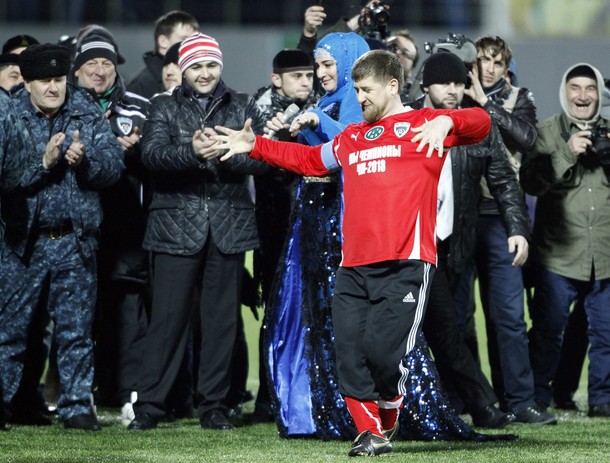
A great example of a Lezginka is usually given by the Chechen President, Ramzan Kadyrov:


I think what happened was that, as time went on, women started jumping into the fray. I would guess that this was a very, very late development because even today it is very conceivable for rivals over a woman to get into a fight if she dances with one of them and leaves the other alone. But, in any case, that the introduction of women into this dance is a new development is also evidenced by how thoroughly boring the woman's dance is compared to the man's: it is basically gliding in circles while making elegant gestures with the hands. The footwork, if any, is limited to imitation. Consider this video of Lezginka being performed by women at a Chechen Wedding, for example:


And that is the "evolutionary" curve that the Lezginka has gone through: it began as a war dance, women joined in, and it then became a spectacle for people to watch, vicariously enjoy, and clap for entertainment: the concert ends at 8 PM so you can get to work on time the next day. And that's generally the curve of culture from pre-modern to late modern. Savage and exhilarating in the beginning; beautiful-ish and civil toward the middle.


Here's a diagram of the steps so you can learn how to do a Lezginka :


Description of the moves :


Man: Raise your shoulders in a broad manner and keep your arms outstretched while bending them slightly in the same direction. Your fingers should be open, however, every so often, make a fist while bending your arms. Your legs should bend slightly while stomping on the ground and crossing your feet. The most important part of the Lesginka should be to be close to your female partner NEVER touching her. You should encircle her while moving your arms around her. You should give the impression of being jagged and hard, but also flowing at the same time.


Woman: Keep your arms raised above your shoulders while veiling your face with your fingers as if you were tickling the air. Walk softly, flutter close to your partner but also give him the impression that he needs to "follow" your lead. Maintain eye-contact with him while walking gently, crossing your feet. You ought to conjure a feeling of softness.


Lezginka Dance Instructions

The Wolf Of The Caucasus

Thursday, 21 June 2012

Putin the peacemaker for Syria? That's not how it's worked out in Chechnya and Georgia

Barack Obama’s latest plan to save Syria is to outsource the problem to Russia. It's a solution tantamount to inviting a date rapist to lead a Take Back the Night rally. But it’s entirely consistent with the administration’s foreign policy in general, premised on the idea that regimes which blame the United States for their own political instability or rampant criminality don’t really mean what they say and can be charmed into comity.


Since the start of the Syrian uprising, Russia has consistently defended Syria at the UN Security Council, amplifying its defense in direct proportion to gruesomeness evidenced by the Assad regime. It has blamed the Syrian opposition for atrocities clearly carried out by proxies of that regime. Despite professing a commitment to Kofi Annan’s six-point cease-fire agreement, Russia has continued to arm Assad with the latest battle tanks, air defense systems and who knows what else, denying that any of this will be used against the civilian population. Even as the grisly massacre in Houla got underway, a Russian-flagged vessel – this one owned by billionaire oligarch Vladimir Lisin – was docking in the port of Tartus to offload yet another consignment of weapons.


Alexander Golts in The Moscow Times has written the best analysis of why Putin continues to back Syria’s dictator even in the face of international reprehension: “Putin identifies with Assad, former Libyan President Muammar Gaddafi and former Egyptian President Hosni Mubarak. He is firmly convinced that democracy, the rule of law and human rights are all little more than contrivances that allow the West to control weaker nations.”


Putin realises that he, too, could wind up in an iron cage in front of a tribunal wanting to know how the price of his personal timepiece collection vastly exceeds his declared annual salary. To prevent this from happening, he has fashioned a funhouse mirror image of the system he believes exists in the West, authoritarianism tricked out as “managed democracy.”


What might a Russian-brokered transition in Syria look like?


Perhaps the best case study is Chechnya, home to another restive Muslim people, summarily categorized as Islamist terrorists and therefore deemed fair game for indiscriminate bombing campaigns, house-to-house raids, rapes and disappearances. Since 2003, Chechnya has been ruled as an undisguised and thoroughly corrupt satrapy of the Kremlin. Its current “president,” Ramzan Kadyrov, has repeatedly rigged elections to give the ruling United Russia Party a Ba’ath-like showing of upwards of 99 percent. Prior to the last Duma election in December, Chechen officials claimed that there were 608,797 registered voters; 611,099 ballots were subsequently cast. According to the US State Department’s 2011 human rights report on Russia, Kadyrov’s  government “continues to violate fundamental freedoms, engage in collective retribution against families of suspected militants, and foster an overall atmosphere of fear and intimidation.” A Syrian Kadyrov is easy enough to imagine: Maher al-Assad, Bashar’s more sadistic brother, could assume the presidency and allow Putin to declare a “cosmetic” transition in effect.


But how can Assad continue to blast cities and villages and deploy his tanks and helicopter gunships even as his Kremlin ally professes its solemn commitment to the Annan protocol? Consider the previous six-point ceasefire agreement Putin signed onto but has subsequently used as kitty litter: the one governing the close of the 2008 Russian-Georgian War. Moscow has not only ignored the plan’s clear demands for the “non-use of force” and for Russia to withdraw its troops from occupied territory, but it has further entrenched Russia’s military and intelligence apparatuses on foreign soil, in clear contravention of international law.


Abkhazia and South Ossetia, the two breakaway regions over which the 2008 war was fought, have effectively been annexed by the Russian Federation, as a new briefing by my colleague Alexandros Petersen shows. Russia has engaged in the deliberate dispossession of ethnic Georgians in these territories, much like Assad’s Alawite-majority militias are now ethnically cleansing Sunni neighbourhoods in Hama. Ten thousand Russian troops and security personnel equipped with battle tanks, artillery and aircraft, are now stationed in South Ossetia and Abkhazia, where many villages have been razed or burnt to ground to make way for Russian military installations. South Ossetia’s entire budget and the majority of Abkhazia’s are funded directly by Moscow and the top ranks of both local “governments” are filled with Russian nationals, many of them agents of Russian military intelligence (GRU) or its domestic intelligence agency, the FSB. The European Union Monitoring Mission (EUMM) designated to observe the terms of the 2008 cease-fire has been routinely prevented from doing so, just as the current UN mission to Syria has been kept by Syrian army checkpoints from surveying the latest massacre in al-Qubeir.


More revealing, though, is the length to which Putin will go to destabilise a pro-Western country in its “near-abroad”, much less a pro-Western opposition in the Mediterranean. US intelligence agencies confirmed what the Georgian Interior Ministry alleged last July: that a Russian GRU officer, Major Yevgeny Borisov, was responsible for 12 bombings and attempting bombings in Georgia throughout 2011, including one at a NATO liaison office and one near the U.S. embassy, both in Tiblisi. Telephone intercepts have shown that Borisov and his subordinates are quite the chatter-bugs with the Russian Defence Ministry whenever something goes off in Georgia. One planned attack involved RDX, a military-grade explosive, which had been placed under a railway bridge in the village of Chaladidi in the western Khobi district of Georgia. It didn’t explode. But Borisov’s deputy made the mistake of phoning the EUMM offices to inquire about the blast and offer his assistance with any resulting casualties; days later, local residents discovered the device.


Syrians can tell you how familiar all of this sounds. And Obama is surely aware that the sower of such cynicism and chaos isn’t going to sincerely assume the mantle of peacemaker. The irony is that this unconscionable re-casting of Putin’s role in Syria is a testament to a pending election in the United States that might well toss an embattled incumbent from office.

The Wolf Of The Caucasus


Originally Posted Here

Monday, 18 June 2012

Drop Me Off Here Episode - Georgia

in the very first episode drop me off here chose to visit the country of Georgia.

Located in the Southern Caucasus group with neighbouring countries Turkey, Russia, Azerbaijan and Armenia; Georgia has a little of everything it seems. From the soaring mountains and ski fields of the Greater Caucasus Range with the rarely visited village communities nestled around glacier fed rivers, to the warmth and joy of the Black Sea coast where one can still find seclusion in the mid-summer on its vast coastline.

They spent two weeks exploring this amazing place and left with the breath-taking memory of a country we knew nothing about.

Drop Me Off Here aims to show you just how easy and unpredictable unplanned travel can be!

Bringing back the concept of travel how it used to be, we encourage travellers to ditch the guidebook, phrasebook, compass and all other travelling tools and just rely on there own skills. There are not too many places left undiscovered in this world and with travel reaching a new level of popularity, so by taking it back to a 'grass roots' level brings a new sense of discovery and exploration to your adventure.


 Full Episode


The Wolf Of The Caucasus


The Georgia - Abkhazia War, The Forgotten Conflict


The Georgia-Abkhazia War, in which ethnic Abkhazians effectively extracted northwestern Georgia from Tbilisi’s control, is a conflict largely forgotten in the West, despite its high profile re-ignition in August 2008.  Historical arguments can be made both for Abkhazia’s unity and autonomy from Georgia, but the conflict cannot be solely blamed on Soviet ‘ethno-federalism’. It must, however, be understood within the context of Georgian independence. 


Ethnic tension between Abkhazians and Georgians was a necessary but not sufficient cause for the conflict.  It took an unstable transition in Moscow, and chaotic Russian involvement in the run-up to the conflict, to turn tension into violence.  Russia’s one-sided role in ending hostilities meant that the conflict’s causal issues were left frozen, only to be violently thawed fifteen years later.


The War in Abkhazia raged from August 1992 to September 1993 was waged between Georgian government forces on one side and Abkhaz separatist forces supporting independence of Abkhazia from Georgia, Russian armed forces and North Caucasian hired fighters on the other side.

Ethnic Georgians, who lived in Abkhazia fought largely on the side of Georgian government forces. Ethnic Armenians and Russians within Abkhazia's population, largely supported Abkhazians and many fought on their side. The separatists were supported by thousands of the North Caucasus and Cossack militants and by the Russian forces stationed in and near Abkhazia.

Handling of this conflict was aggravated by the civil strife in Georgia proper between the supporters of the ousted Georgian president, Zviad Gamsakhurdia and the post-coup government headed by Eduard Shevardnadze, as well as the Georgian-Ossetian conflict.

Significant human rights violations and atrocities were reported on all sides and peaked in the aftermath of the Abkhaz capture of Sukhumi on 27 September 1993, which was followed by a large-scale campaign of ethnic cleansing against ethnic Georgian population according to the Organization for Security and Co-operation in Europe.

 The UN SG’s fact-finding mission reported numerous and serious human rights violations committed by both Abkhazians and Georgians. From 13,000 to 20,000 ethnic Georgians and approximately 3,000 Abkhaz have been reported to be killed, more than 250,000 Georgians became internally displaced or refugees and 2,000 are considered missing.

Post-Soviet Georgia was heavily affected by the war and suffered considerable financial, human and psychological damage. Abkhazia has been devastated by the war and subsequent continued sporadic conflict.

The Wolf Of The Caucasus


Sunday, 17 June 2012

Dutch Journalist Killed By Russian Forces In Georgia


2008: Stan Storimans, a 39-year-old Dutch cameraman who worked for the Hilversum-based television channel RTL Nieuws, was killed in an attack in the central Georgian city of Gori. His colleague, reporter Jeroen Akkermans, suffered shrapnel wounds to his leg and was hospitalized in a Tbilisi clinic, Jaspir Teijsse, a spokesman for RTL Nieuws, told CPJ.
Storimans and Akkermans had traveled from Tbilisi to Gori early on August 12 to report on overnight strikes by Russian forces, Teijsse said. The reporters were with five others in Gori's town square when they were struck by the blast at about 8:30 a.m.
A Dutch government probe found that a Russian cluster bomb was the source of the attack, prompting protests from that country's foreign minister, Maxime Verhagen, according to international press reports. The Russian Ministry of Foreign Affairs disputed the finding.
The Wolf Of The Caucasus


The Georgian Chokha

The Chokha is part of the traditional dress of the male population of the Caucasus.


France may be known for its berets, and Spain for its mantillas, but few national costumes are linked to as such a strong sense of national pride as Georgia’s chokhas.


Dating back to the Middle Ages, the Chokha is a calf-length, wool coat for men inherent to the Caucasus, distinguishable by the bandoleers sewn across the breast and its tapered waist cut. Accessories typically include a hood, tall leather boots and a belt holding a long, embossed dagger, called a khanjali.


Nearly every Georgian household is proudly adorned with photos of their family ancestors wearing chokhas. Once a symbol of resistance to Bolshevik Russia’s 1921 takeover of an independent Georgia, the chokha has now come to represent a Georgia reborn, a country that revels in its cultural individuality.


Increasingly worn by Georgian men at weddings and official functions, the eye-catching coat is finally experiencing a comeback.


“When you love your chokha, you love your country. When you love your country, you love your traditions,” elaborated 60-year-old Rezo Sulava, a leader of the All-Georgia Chokha Society


The chokha revival is taking place in parallel with a resurgence of interest in other mainstays of Georgian culture – the Georgian Orthodox Church, Georgian folk dancing, and choral singing.


Holding onto the country’s chokha tradition, though, has not always been easy. By the early 20th century, European fashions had replaced the chokha; in Soviet times, the coat was largely a stage costume, mostly worn in public by Georgian folk dance ensembles.


“The chokha has been in a terrible coma and we’re trying to resurrect it,” said Luarsab Togonidze, a folklorist and co-owner of Samoseli Pirveli ( “First Clothes”), a slick Tbilisi boutique that specializes in the recreation of traditional Georgian clothing.


By studying museum collections, old photographs and private wardrobes throughout the country, Togonidze and his business partner, Levan Vasadze, created a chokha atelier (prices start at 200 lari, about $113 ) for a growing niche market.


That market – among it, the glitterati of Georgian artistic and theater circles – turned out in number at a February 6 fashion show Samoseli Pirveli staged in a champagne factory outside of Tbilisi.


Sashaying and swaying through the crowd, dancers from Georgia’s Sukhishvili and Rustavi folk dance ensembles showed off embroidered, Sleeping-Beauty-style wedding gowns for women, fitted, cropped jackets with cummerbunds for men, and, of course, chokhas.


But, unlike many Georgian traditionalists, Togonidze caters to customers looking for more contemporary takes on these long-established looks. His designers also create made-to-order dresses inspired by chokhas – a fashion statement embraced by many of the women attending the Samoseli Pirveli fashion show.


Some Georgians, however, feel that altering the design of the chokha is tantamount to sacrilege.


“Women shouldn’t wear chokhas,” asserted All- Georgia Chokha Society leader Sulava. The society’s 1,000 male members, or “chokhosanebi” (literally, “chokha people”), are headed by the powerful Patriarch Ilia II and act as the patriarch’s honorary guards, attending all religious celebrations and national festivals in uniform.


Set up in 1952 as an attempt to protect Georgian traditions from Soviet encroachment, the league today tries to preserve Georgian traditions from globalization.


“The chokha emphasizes I am a Georgian. It is a spiritual costume,” Sulava elaborated.


Sukhishvili dancer Tea Darchia, though, rebuffs that disapproval. “Pants were made for men and women wear them. Why can’t we wear the chokha?” Darchia posited.


Others, though, like event organizer Sandro Kakulia, believe that wearing the chockha has become trendy for the wrong reasons. “It’s fashionable now, not because people love the symbol, but they are following a trend. It’s elitist,” Kakulia said.


But unlike most fashion trends, wearing a chokha demands a certain responsibility. Even boutique owner Togonidze, who is not a Society member, says “there’s something magic” to wearing a chokha. “It has an effect on your behavior. People treat you differently.”


Chokhosanebi follow a code that regulates everything from the color of the chokha they wear (burgundy, white, black and gray are the standard colors), to how it is worn (with high-collared shirts always buttoned to the top), to how men must sit with their khinjalis (not dangling between their legs and not pointing up at a neighbor).


Some, however, argue that such reverence reflects an unhealthy understanding of Georgia’s traditions, by promoting living in the past rather than looking to the future.


The Indie-rock group Dervishebi (Dervishes) performs a parody of the classic Georgian song “Suliko” in electric-colored chokhas and Converse high-tops -- much to the ire of Georgian traditionalists and conservative members of the Orthodox Church.


“Everyone has their own relationship with the chokha,” said Dervishebi singer Guga Gegetchkori. “It’s only a national dress, that’s all. It’s not holy. It’s like a t-shirt.”


Boutique co-owner Togonidze concedes that “chokha radicals” can get carried away.


The chokha may be a strong representation of Georgian national pride, he commented, but fans should keep their passion in perspective. “It’s the 21st century,” he said. “You don’t have to overdo it.”


The Wolf Of The Caucasus


The Caucasian Mountain Shepherd

The Caucasian Shepherd, which is also known as the Caucasian Ovtcharka, formerly as the Georgian Shepherd but this was forced to change under the USSR occupation, is a mountain dog from the Caucasus Region. This breed was originally a sheep dog and converted to be a border patrol dog in the East Germany army in the early 1960s. 


The dog is an ancient breed that for centuries was little known outside the remote regions from which it comes from, namely the Caucasus which incorporate the following countries, states and republics: Chechnya, Dagestan, Ingushetia, Adyghea, Kabardino-Balkaria, Karachay–Cherkessia, North Ossetia, Krasnodar Krai, Stavropol Krai, Armenia, Azerbaijan, Georgia, Adjara and Abkhazia. 

The Caucasian shepherd is a member of the working group of dog breed and despite its appellation of sheepdog/shepherd this dog was never a livestock herder but rather a guardian or protector which goes back a long way in explaining its not inconsiderable size! The Caucasian Mountain dog was bred to protect livestock against wolves, bears and other predators; in fact the Caucasian Ovcharka even has an uncanny resemblance to a bear!


The dog can be aggressive and dangerous once they are trained to attack strangers. The dog is not suitable to be kept as a pet because of their territorial and dominant instinct. An adult female Caucasian Mountain dog is usually 27 inches tall an120 lbs in weight. This is one of largest breed of dog in Europe and around the Caucasus region.


The Wolf Of The Caucasus